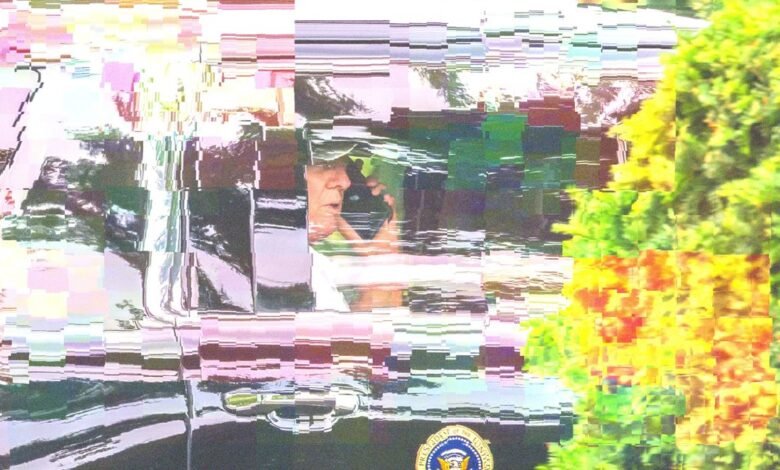

Photo-Illustration: Intelligencer; Photo: Getty Images
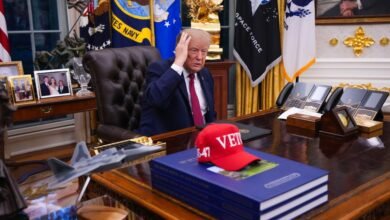
The president sits alone in the middle of a vast structure, yelling. Around him, a trickle of people — some familiar, others interchangeable — come to say what they’re supposed to say and pretend to listen. The architecture itself is familiar to everyone yet has been made to feel shoddy, insisting constantly on its own greatness: This is the “most powerful” place, the chief executive declares unprompted and to no one in particular. Images of the man are everywhere, as are stacks of sycophantic articles and misleading charts and numbers strewn about in case he passes by. There is nothing left here for anyone but him. The structure, built with grand ambitions, has become a care home, a symbol of decline, a bunker. It is a place fewer and fewer people want to visit, constantly renovated around a person they no longer want to hear from.
I’m talking, of course, about Truth Social.
If you want a preview of what the Trump era will look like in the aftermath of Tuesday’s midterm blowout, you could do worse than to look at his failed social-media platform. Announced in 2021, when former and future president Trump was still banned from Twitter and Facebook, and released to the public the next year, the platform was devised, in his words, to “stand up to Big Tech.” For the next five years, it was often where Donald Trump, first as a private citizen and then as president, spoke first — at an average of more than 22 times per day.

Photo: Defending Democracy Together
Unlike Trump’s presidency, Truth Social was never a real cultural force. Its importance, instead, was mandatory: The president owned it, and the president was there. Its name was uttered thousands of times by TV-news anchors and government officials, a constant reminder that he had the power to make them look and that American governance ran directly through him and his personal website. As he lost his mandate — such as it was — Truth Social became, instead, arbitrary and absurd. Even the platform’s users, a small group of mass-posting true believers flanked by poorly concealed bots, were paying less attention. The collapse happened there first. And so did Trump’s response: He started posting more. (On Friday, Trump used the site to announce Stephen Miller would be taking over as chief of staff; Miller, who hasn’t posted on Truth Social since late 2025, wrote his own announcement on X.)
Truth Social never consistently broke a million users a day, even according to its own suspicious numbers; its traffic peaked, to use the word generously, in June 2025. It had no distinct platform culture to speak of or cultural footprint beyond its own feeds, which were often filled with MAGA-tribute-act-level image memes borrowed from Facebook circa 2016. As an alternative to Twitter for the right, it never took off; shortly after it launched, Elon Musk bought Twitter anyway, unbanned Trump, and remade the site in his image. The peak of real-world influence for Truth Social’s non-Trump users arguably came in August 2022, when a user opened fire on a Cincinnati FBI building with a nail gun, then used the platform to post that “it is true I tried attacking the F.B.I.” (He was killed by police.) Since then, the platform has been remarkably self-contained, a “potent spreader” of misinformation, according to researchers, but only within its own walls. As a “social-media platform” in any widely agreed-upon definition of the term, Truth Social doesn’t really exist and never has. It was a platform-shaped website built around a single person, less of a network than a few thousand feeds downstream from one guy.
Trump’s posts functioned as press releases with comment sections, re-shared on the far more popular X and across other social-media sites. It was often, technically, where America found out about new tariffs, administration appointments, mass purges, and foreign interventions up to and including major escalations in Iran; it was where cease-fires between Israel and Hamas, and then again between the United States and Iran, materialized and disappeared repeatedly; it was where citizens of U.S. cities first heard their streets would soon be filled with ICE agents or the National Guard; it was where Trump announced pardons and stunts, architectural projects and renamings (of places, holidays, and artificial intelligence). Like Twitter during his first term, it was the narrow channel through which his presidency’s communication flowed.

Photo: Truth Social
For those who couldn’t wait a few extra seconds for the president’s posts to show up everywhere else — and who might be able to extract value from knowing about, say, an air strike a few moments before the rest of the market — Truth Social announced earlier this year that it would charge customers $100,000 per month for early access to posts, an offer that was accepted by a small number of firms, including Bloomberg.
Which brings us to the other most pertinent fact about Truth Social: As a business, it was, from the start, an obvious grift. In 2021, its newly launched parent company went public through a SPAC — remember those? — in a bid to attract public investment. After years of investigation and delay, the stock debuted in March 2024 and soared, initially. Trump Media & Technology Group, much of which was owned by Trump himself, was briefly valued at nearly $9 billion. That year, revenue was in the low-single-digit millions, comparable to a successful McDonald’s franchise; unlike a McDonald’s franchise, that year it would lose $186 million. There was a streaming service and a pivot to crypto, not to mention a “bitcoin treasury” plan as well as one for a prediction market. Currently, the company is in the process of merging with a nuclear-fusion firm in an apparent attempt to capitalize on the AI boom, a plan it announced, seemingly out of nowhere, in 2025. Shortly after its IPO, stock in Truth Social’s parent company closed above $66 a share. Today, it closed below $5, an all-time low. (Trump’s crypto coin has followed an even more severe trajectory.) Every last person who bought into the company after its IPO is now deep underwater. Much in the way Truth Social was never really a social network, it was never really a business, either.
Most people knew this, of course: the people listening to pundits vocalize on-air about the president’s “Truth Social posts”; the investors who thought they might make some cash on a meme stock anyway, or that it would be buoyed by an eternal MAGA movement; the institutional investors that bought in for reasons they neither wanted nor needed to articulate. But while the Trump administration lost its last remaining momentum on Tuesday, Truth Social entered its lame-duck period more than a year ago, the moment the president’s popularity crested. Going into the midterms, the platform was a ghost town where even the bots seemed tired. Trump pumped out an unreadable cascade of endorsements for different states, one after the other. He wrote that “Abdul El-Sayed Hates Jews and Hates Blacks. Don’t feel bad, he also Hates Whites,” adding, “He will, 100%, do you in!” He threatened prosecution in Alaska over “ELECTION FRAUD” by “DUMOCRATS” and posted a link about how his midterm travel “Runs Circles Around Obama, Biden.” There was a post about the Reflecting Pool, a Mike Lawler endorsement, and a video from right-wing influencer Benny Johnson about Florida turnout. (“And there’s going to be a blue wave everywhere else? I don’t believe it,” he said.) There was a Sean Hannity clip assuring viewers the races were all a “dead heat,” in which a guest said candidates should be thankful for Trump, and a not so comforting post about Republicans flipping … Guam. This was followed by a complaint about another Fox News personality’s voice — “DUMB AS A ROCK, but it’s the voice that gets me” — followed by another post about Fox News:
The FoxNews Poll, always the worst, is so insulting with the questions they ask. Every question is a hit job, and every answer is “BULLSHIT!” This has been going on for years. President DONALD J. TRUMP
When the blue-wave scenario became clear, Trump posted, “I wasn’t on the Ballot and if I was, we would have won IN A LANDSLIDE! Thank you for your attention to this matter.” (But not before devoting, mid-wipeout, nearly 200 words to Fox’s bad ratings.) Beneath each post were thousands of replies, many of which didn’t engage with his text at all and almost none of which engaged with one another.
He eventually landed on an unusually self-aware closing message:

Photo: Truth Social
Lame-duck Trump can do a lot of damage, both here and abroad, as president of the United States. On Truth Social, though, his future as a public figure has been on display for months now: an endless series of posts seen by fewer and fewer people, many of whom aren’t sure why they need to listen to them anymore.
Source link